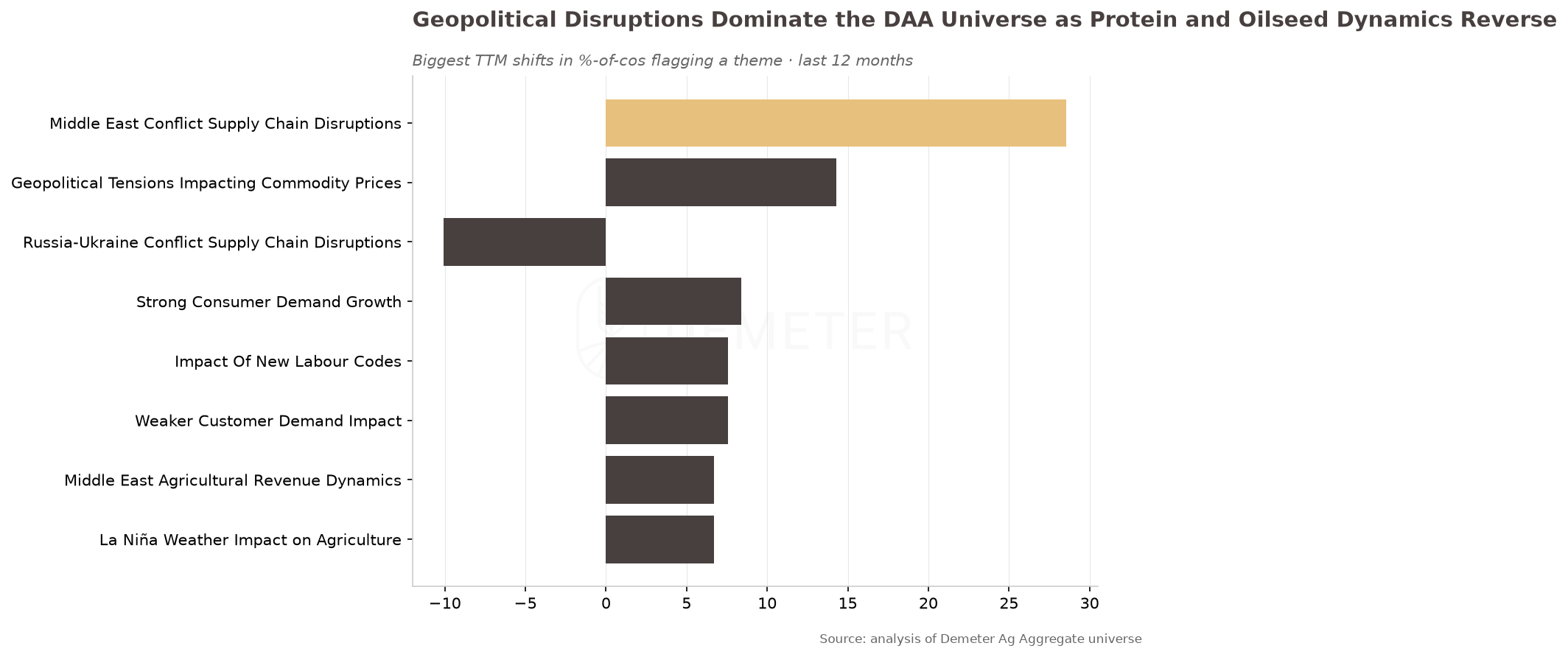
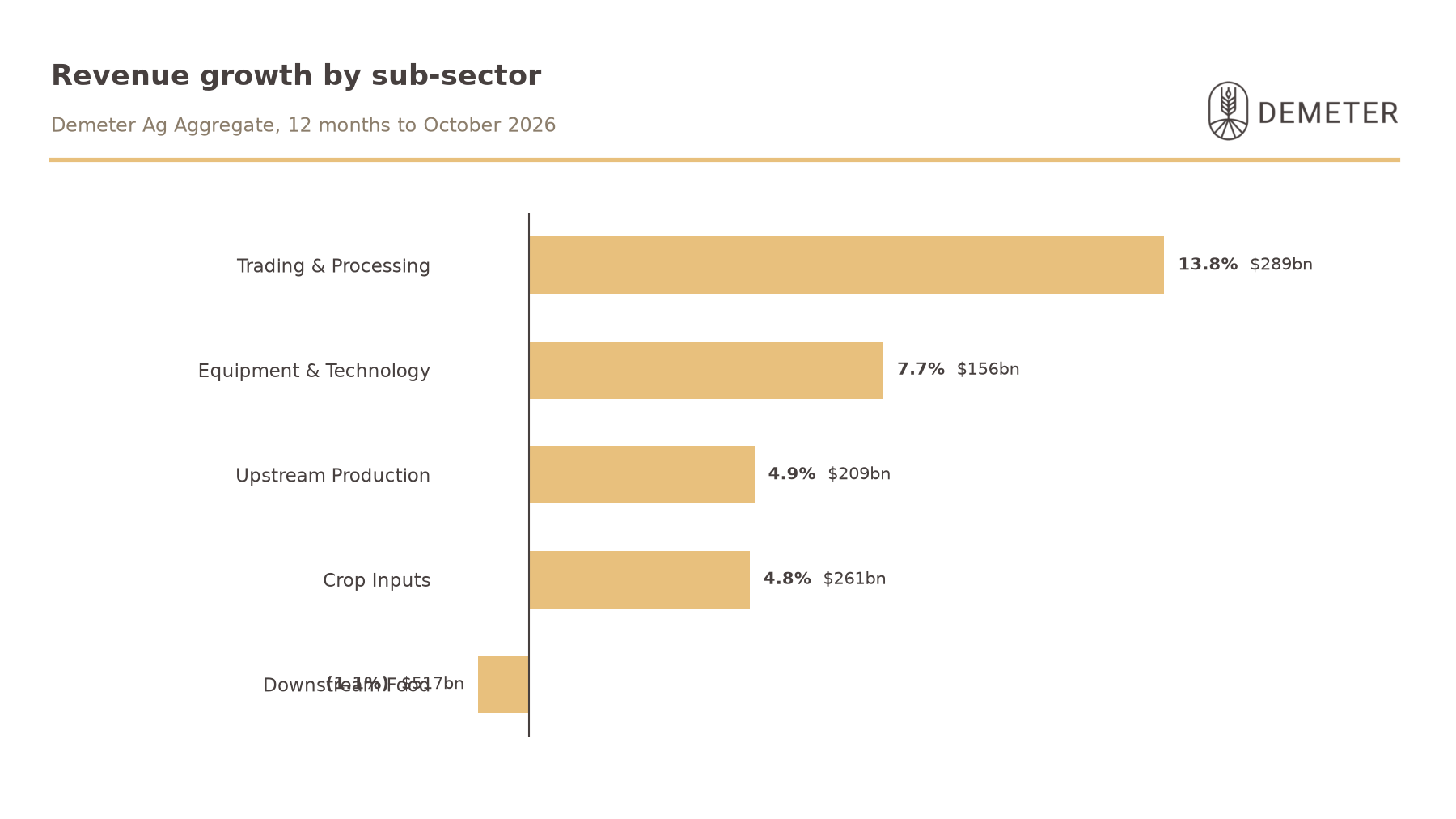
11 DAA companies raised this theme in disclosures dated 2026-05-06 → 2026-11-06.
# Headline
Across 11 covered companies filing between 6 May and 6 November 2026, the dominant disclosure is the effect of the conflict involving Iran, Israel and the USA on fertiliser supply and pricing — halted vessel transport through the Strait of Hormuz, constrained ammonia and sulphur availability, and sharply higher benchmark prices. OCP Group reported fertiliser prices rising to $715 per tonne in the first half of 2026 from $589 a year earlier, while Ridley booked higher fertiliser margins on the same price move. Several producers reported that higher prices cut volumes: OCP Group (MA) cited reduced farmer affordability, Nutrien lower fertiliser volumes, and The Mosaic Company a 23% production decline tied to sulphur availability.
# Forces
# Fertiliser benchmark prices at $715/tonne
3 of 11 companies
OCP Group (MA), in its late-September financial reporting, attributed the move from $589 per tonne in the first half of 2025 to $715 per tonne in the first half of 2026 to higher raw material costs, particularly sulphur, and said the higher prices reduced farmer affordability and drove a decline in global demand that hit Group sales. Ridley, in its 20 August annual results and accompanying investor presentation, reported higher margins in its Fertilisers segment on rising global market prices linked to the Middle East conflict, partially offset by lower than expected volumes as farm economics deteriorated. ICL Group (IL), in disclosures dated 5 August, reported price increases across its fertiliser, food and industrial markets on strong demand and market conditions.
"The increase in fertilizer prices from $589 per tonne in the first half of 2025 to $715 per tonne in the first half of 2026 was driven by higher raw material costs, particularly sulfur prices."
— OCP Group (OCP), Financial Report, 2026-09-28
# Nitrogen prices and the Strait of Hormuz
3 of 11 companies
CF Industries (US), on 7 May, reported that the conflict with Iran caused additional nitrogen fertiliser supply constraints and price volatility after vessel transport through the Strait of Hormuz was halted. SLC Agrícola said on 11 May it was monitoring the nitrogen fertiliser market closely given the impacts of the conflict between the USA, Israel and Iran on global fertiliser markets and on its costs. Yara International, in its half-year reporting on 17 July, said high margins supported return on invested capital despite lower deliveries from off-season demand and volatile nitrogen prices.
"The ongoing conflict with Iran has caused additional nitrogen fertilizer supply constraints and price volatility due to halted vessel transport through the Strait of Hormuz."
— CF Industries (CF), 10-Q, 2026-05-07
# Sulphur costs
2 of 11 companies
OCP Group (MA), in reporting dated 29 September, said the exceptional increase in sulphur costs could not be fully passed through into fertiliser prices because affordability constraints limited the market's ability to absorb it. China BlueChemical, in its interim results announced on 19 August, said a significant increase in sulphur prices together with Middle East geopolitical turbulence supported the domestic fertiliser market in the first half of 2026, despite fluctuating seasonal demand.
"The exceptional increase in sulfur costs could not be fully passed through into fertilizer prices due to affordability constraints limiting the market's ability to absorb the increase."
— OCP Group (OCP), Financial Report, 2026-09-29
# Farmers' fertiliser basket cost
2 of 11 companies
SLC Agrícola, in its 11 May quarterly reporting, tied higher costs and delays in nitrogen fertiliser production to restrictions imposed by Iran, which it said affected up to 30% of global fertiliser trade. OCP Group (MA), in half-year disclosures dated 29 September, said affordability had improved since the second-quarter peaks, with firmer crop prices and lower nitrogen and potash prices reducing the total fertiliser basket cost for farmers.
"The increase in costs and delays in nitrogen fertilizer production were driven by restrictions imposed by Iran, which affected up to 30% of global fertilizer trade."
— SLC Agrícola (SLCE3.SA), Quarterly Results, 2026-05-11
# Elsewhere: ammonia, gas, phosphoric acid and sulphur supply
CF Industries (US), on 6 May, reported higher average selling prices for ammonia on a tight global nitrogen supply-demand balance exacerbated by the Iran conflict, alongside higher realised natural gas costs that raised first-quarter 2026 cost of sales versus a year earlier. Nutrien, on 5 August, said lower fertiliser volumes and increased sulphur costs offset the benefit of higher global fertiliser benchmarks, reducing second-quarter net earnings and adjusted EBITDA. The Mosaic Company reported on 4 November that production of crop nutrient dry concentrates and animal feed ingredients fell 23% in the three months to 30 September on raw material availability constraints, particularly sulphur. Coromandel International said on 15 May that Middle East supply disruptions lifted ammonia and sulphur prices and created finished-fertiliser availability challenges, and on 31 July that the government's 10% subsidy increase for nitrogen, phosphatic and sulphur nutrients did not fully compensate for higher global raw material costs. Chambal Fertilisers and Chemicals pointed on 20 May to elevated energy and LNG prices pressuring import economics and sourcing costs, and on 6 August warned that delayed subsidy announcements and low local NPK production could cause demand destruction at higher farmer prices. Ridley disclosed on 23 May a framework agreement with Export Finance Australia to fund additional fertiliser cargos against potential Australian shortfalls, noting Incitec Pivot Fertilisers was carrying stocks in expectation of short-term nitrogen demand despite possible product outages.
Demeter Theme Spotlight · 2026-11-06 · grounded in companies' own filing disclosures.
Explore more Demeter research at demeterdata.ag/research and the live Demeter index family — including the Demeter Ag Aggregate (DAA) equity indices — at demeterdata.ag/indices. To receive Demeter Ag Aggregate bulletins by email, subscribe here.